
Digital from 3,000 pcs, flexo for high volumes
Calculate priceCustom Coffee Bags with One-Way Degassing Valve
Stand-up pouches with degassing valve and high aroma protection for freshly roasted coffee and tea.
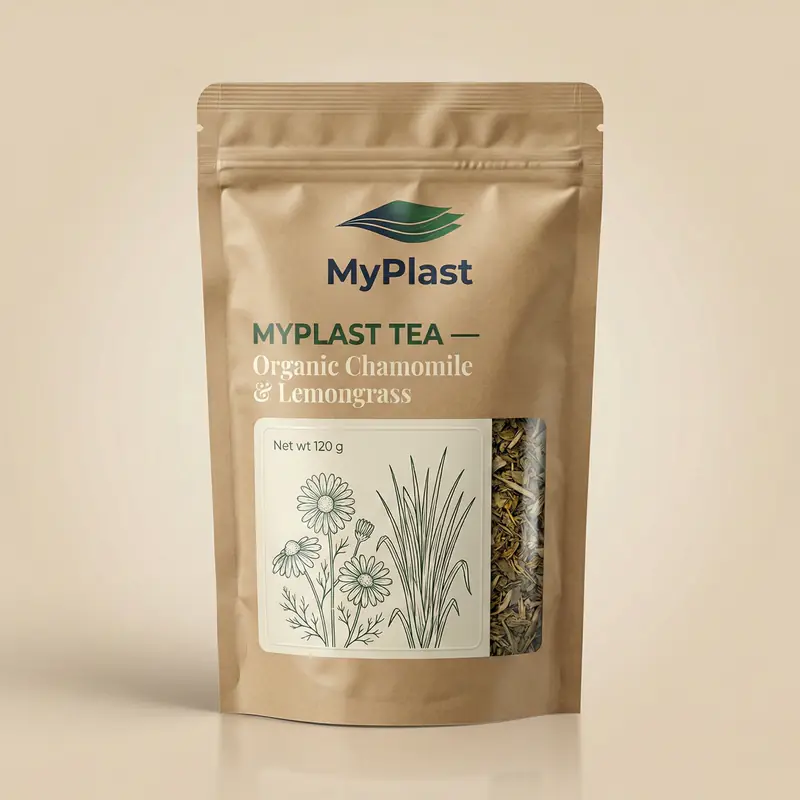
A coffee bag has two jobs: let out the carbon dioxide that freshly roasted beans release, and keep oxygen and light out. So a good coffee bag is a one-way degassing valve, a high-barrier laminate and a zipper that keeps protecting after opening. MyPlast makes custom coffee bags as stand-up pouches, flat bottom bags and side-gusset bags — printed from 3,000 per size, or unprinted from stock from 500.
- Custom print
- From 3,000 per size
- Production
- 14-40 business days (by print method)
- Printing
- Rotogravure, up to 10 colours
- Certifications
- ISO 9001 · ISO 22000
Why a coffee bag needs a degassing valve
Freshly roasted coffee gives off carbon dioxide, most heavily in its first days. Filled straight into a bag without a valve, the bag balloons and the seals are stressed; the roaster either waits for the gas to escape — losing aroma in the meantime — or risks bursting bags.
A one-way valve lets the gas out without letting air back in, so coffee can be packed right after roasting and keeps its aroma in the bag. Ground coffee has far more surface area than whole beans and oxidises faster, which makes the valve and a high barrier even more important.
Which structure for which shelf life
- PET/AL/PE — an aluminium foil layer blocks light completely and gives the strongest oxygen barrier; the standard for whole bean and ground coffee with a long shelf-life target
- Kraft/AL/PE — the same foil barrier behind a paper look, for specialty roasters who want a natural shelf presence
- PET/MPET/PE — metallised, a more economical high barrier for fast-moving coffee that sells through in weeks
- A clear window is not recommended for coffee: light and oxygen through the window stale the aroma quickly
Flat bottom, side gusset or stand-up pouch
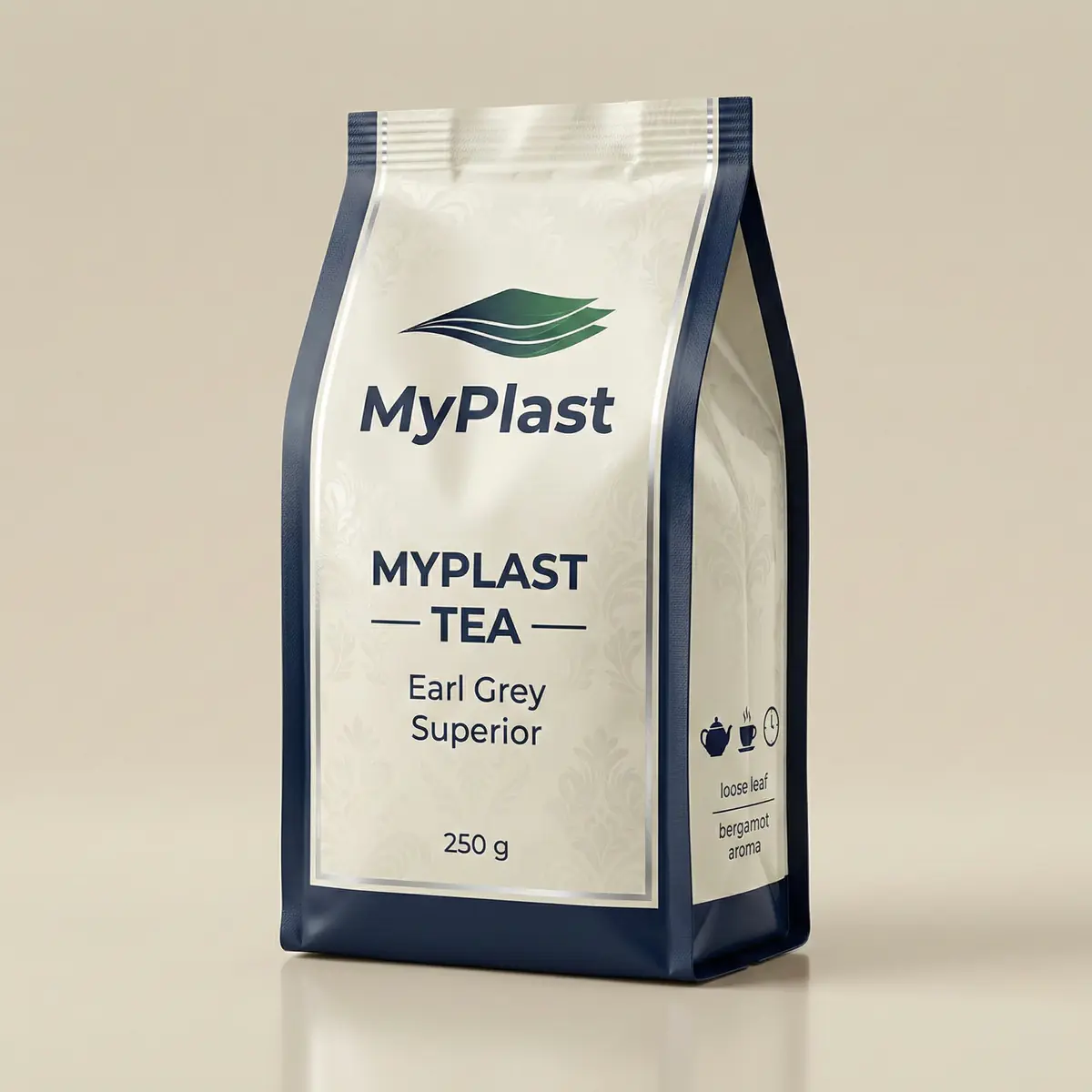
A flat bottom (box) bag stands like a carton, prints on five panels and is the most common choice for premium coffee from 250 g to 1 kg. The side-gusset (quad seal) bag is the classic whole-bean bag and is economical in larger sizes. A stand-up pouch with valve and zipper suits smaller sizes and tea.
The valve sits on the front panel, so its position is planned into the artwork from the start. A zipper lets the customer reclose the bag, but it does not restore the barrier of an unopened pack.
Printing, stock and lead time
- Rotogravure printing up to 10 colours; matte, gloss and soft-touch finishes
- Custom print from 3,000 per size; production 14-40 business days (by print method) after artwork approval
- Unprinted side-gusset and flat bottom bags with valve from stock, from 500 pieces
- Digital proof 24–48 hours after print-ready files; stock samples ship in 48 hours
Frequently asked questions
What happens without a degassing valve?
Freshly roasted coffee releases gas, so a bag without a valve balloons: you either wait for the coffee to degas and lose aroma, or risk the bag bursting. The valve lets gas out and keeps oxygen out.
Do kraft coffee bags protect well enough?
Kraft paper alone does not. In Kraft/AL/PE an aluminium foil layer sits behind the paper, so the barrier matches PET/AL/PE; only the look is different.
Do you fill the bags or nitrogen-flush them?
Filling and nitrogen flushing happen on your packing line; we make the bags and the rollstock. Our bags work with nitrogen flushing and with the valve.
What is the minimum order and lead time?
3,000 pieces per size for custom printed coffee bags, produced in 14-40 business days (by print method). Unprinted bags with valve ship from stock from 500 pieces.
Why MyPlast?
Fast Delivery
14-40 business days (by print method) production for custom print, express on request
Custom Solutions
Packaging design tailored to your product
Sustainability
Eco-friendly materials
Quality Guarantee
ISO production
Quick Response
Quote within 24 hours
25+ Years Experience
Leading company in the sector
Get a Quote Now
Request custom coffee & tea packaging solutions for your project. We will respond within 24 hours.
Request Free QuotePackaging Gallery
Total 9 Images
Similar Industries
Explore our packaging solutions for other industries
About This Packaging
Coffee packaging is the segment where aroma technology is most advanced in flexible packaging. Roasted coffee beans release CO₂ intensively for 72 hours post-roast; this makes degassing valves mandatory in coffee packaging. Without one, the pouch swells and deforms during transit. MyPlast coffee packaging is optimised across the triangle of valve integration, oxygen barrier and aroma retention.
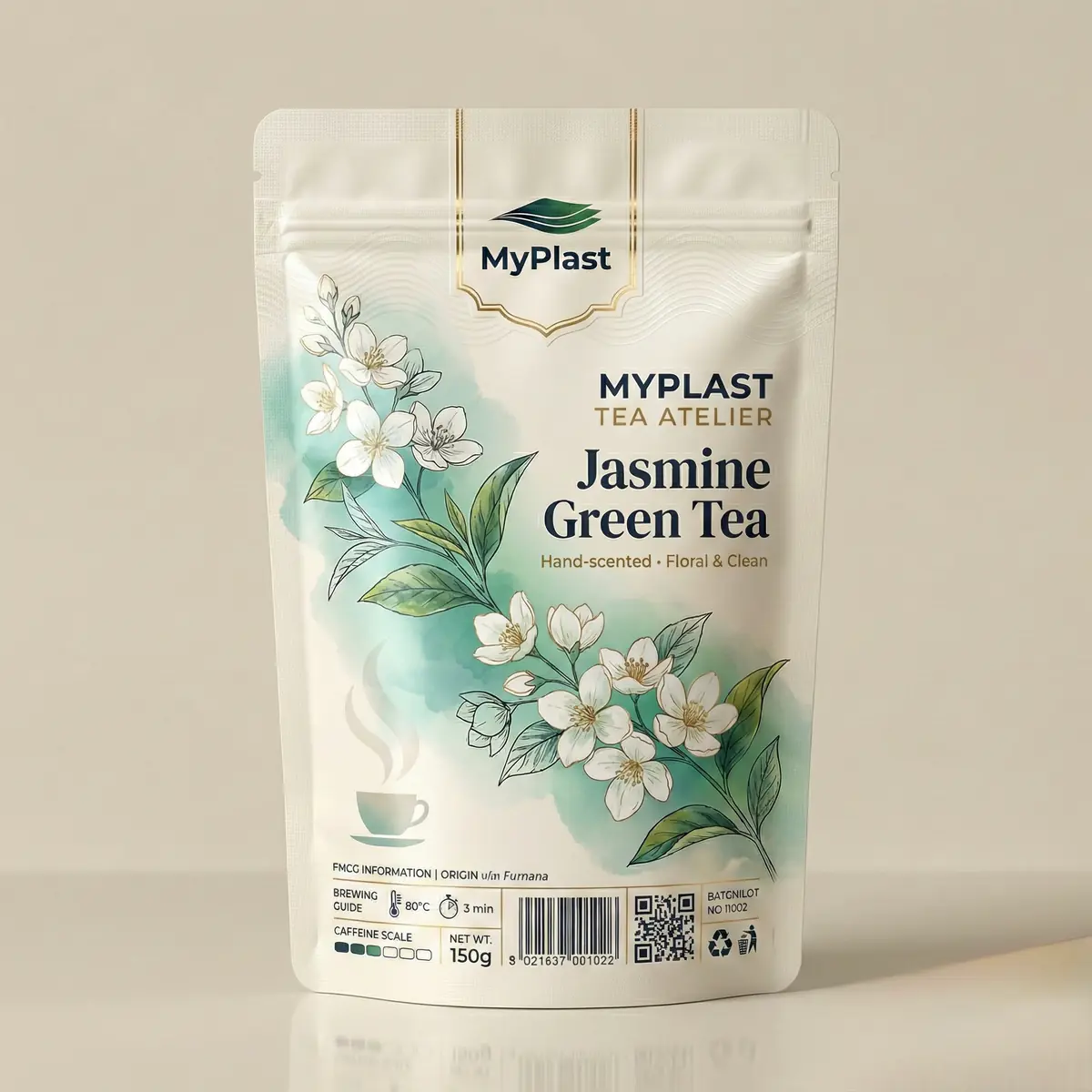
Tea packaging presents different challenges — preservation of volatile aromas and prevention of moisture ingress dominate. Sensitive varieties like green tea and oolong require high oxygen barriers (OTR ≤2 cc/m²/day) against oxidation. Black tea is more stable but still benefits from a metallized barrier to prevent aroma loss. MyPlast serves the full B2B spectrum in coffee and tea — from global chain brands to boutique roasters.
Barrier Requirements
Oxygen barrier (OTR): 70% of coffee aroma is lost in the first 30 days post-roast — if packaging OTR is not below 2 cc/m²/day. MyPlast coffee packaging uses PET/MET-PET/PE or PET/Aluminium/PE structure; the latter delivers OTR ≤0.1 cc/m²/day, practically zero oxygen transfer. For specialty coffee segment (single-origin, single-variety), aluminium foil structure is mandatory.
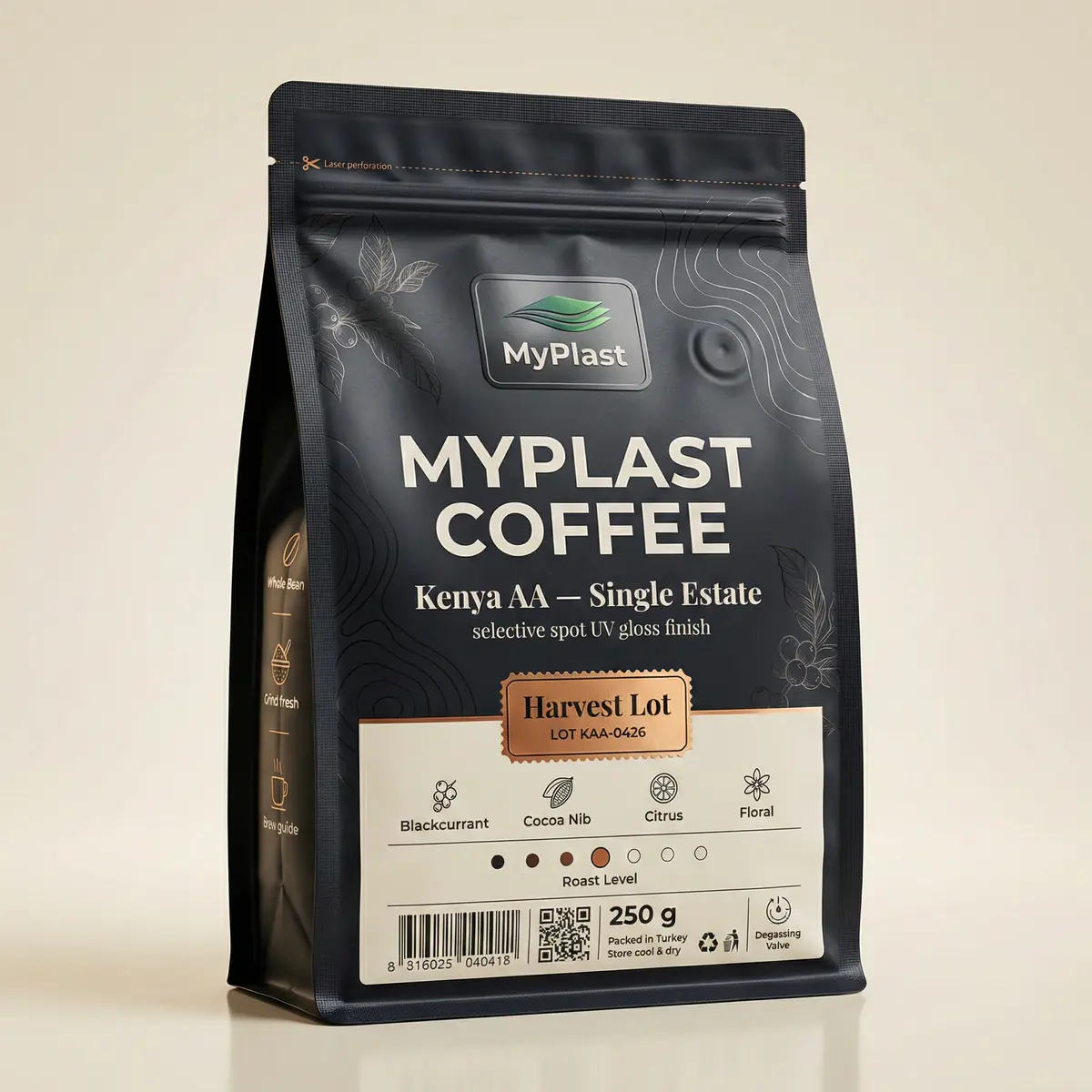
Degassing valve: One-way valve allows CO₂ to escape while blocking oxygen ingress. MyPlast valve integration offers standard filt-type or inertia-disc valve options. Valve placement is upper centre-left of the pouch; this position equalises pressure during transit.
Aroma barrier: Key compounds in coffee aroma (2-furfurylthiol, β-damascenone, methylpyrazine) are low-molecular-weight and pass through standard PE films. EVOH or aluminium barrier captures these volatile compounds.
Material Options
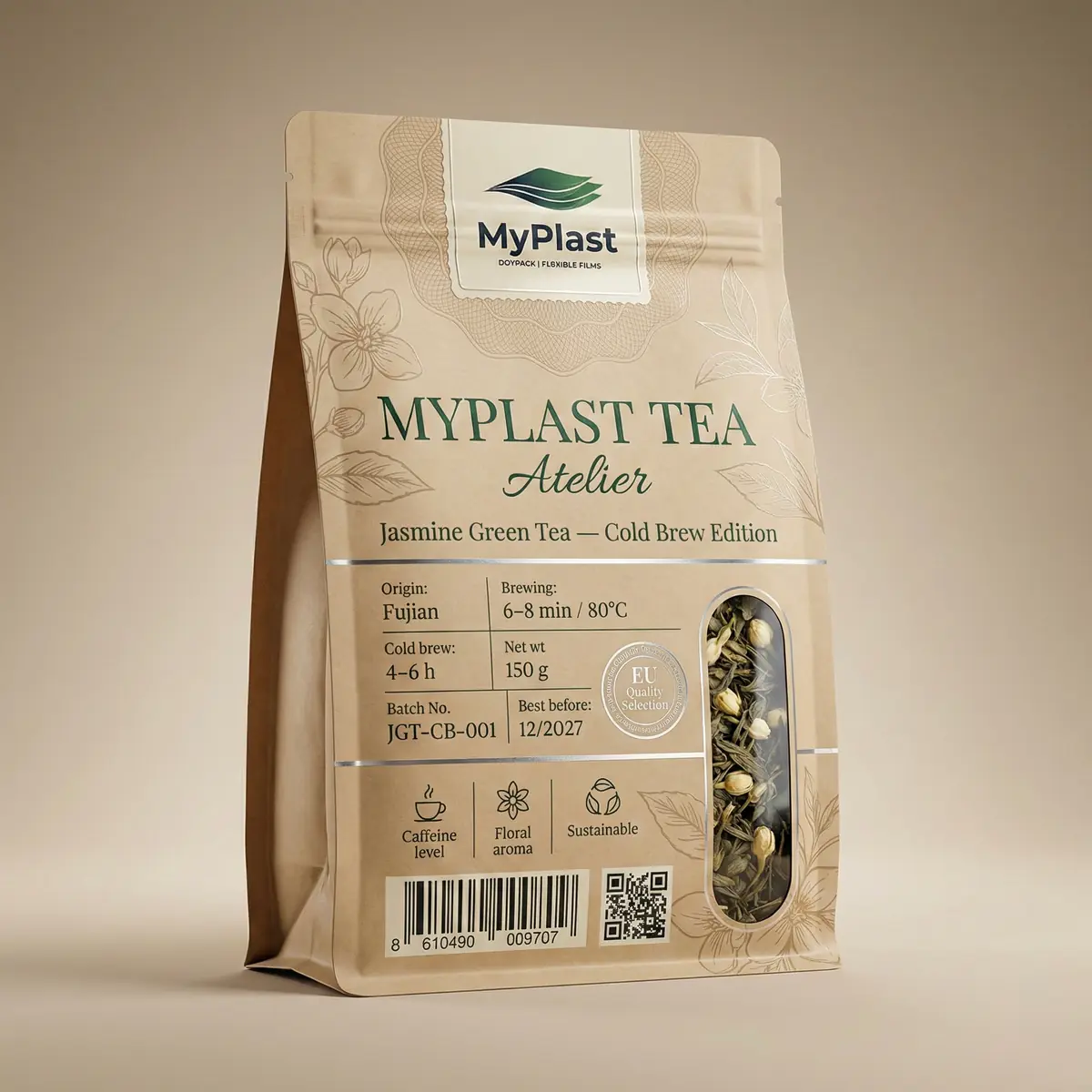
- 1Kraft Aluminium Doypack — the standard for premium coffee segment. Kraft outer layer delivers artisanal identity while inner aluminium foil provides absolute barrier. Preferred for specialty roasters, single-origin and organic coffee brands.
- 2Glossy/Matte Aluminium Doypack — for retail and supermarket channels. Premium print surface and shelf visibility. Standard 250 g, 500 g, 1 kg formats.
- 3Kraft Metallized Flat Bottom — box-look premium packaging. Maximum stand-up stability and shelf visibility. Ideal for café-shop and specialty roaster positioning.
- 4Mono-PE recyclable structure — for sustainability-conscious coffee brands. Combined with biodegradable valve option, creates a fully circular pack solution.
Packaging Format Options
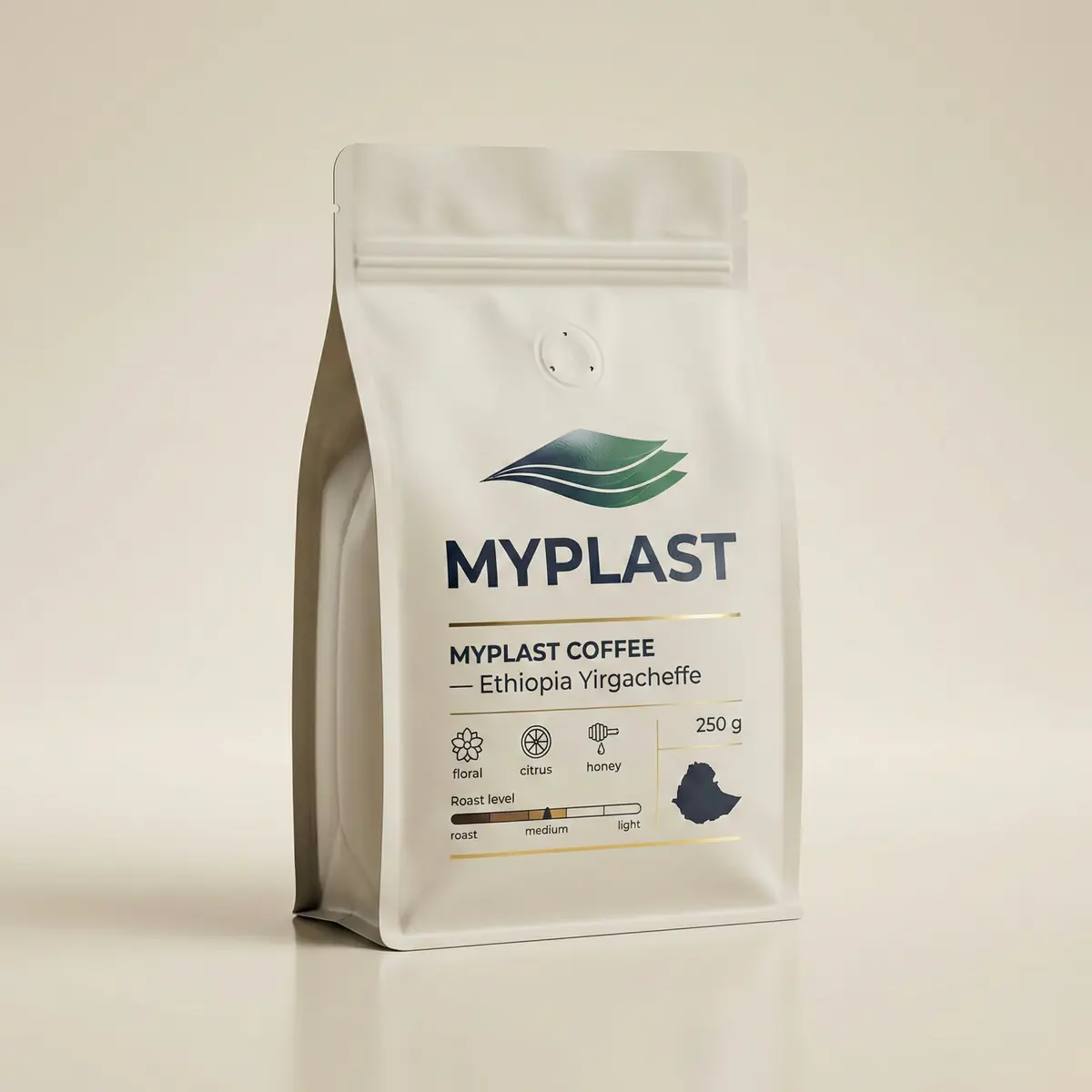
Doypack 250g (specialty coffee): Standard format for single-origin and premium roast segment. Degassing valve and zipper as standard. Kraft or aluminium outer surface options.
Doypack 500g - 1kg (retail): Most common format for supermarket and retail channels. Side-seal or centre-seal. Tear-notch for easy opening.
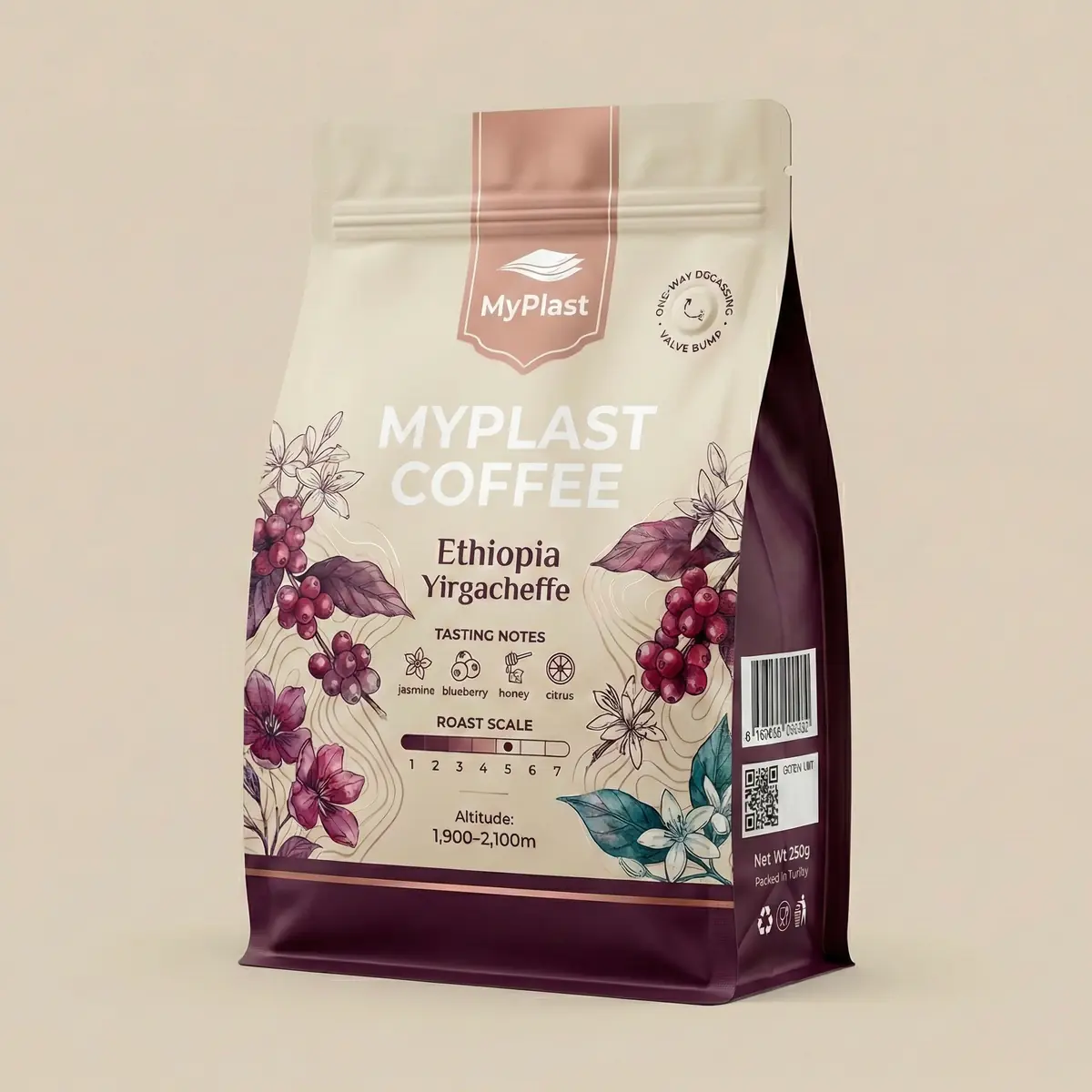
Flat-bottom 250g - 1kg (premium): Maximum box appearance and shelf stability. Visually striking premium packaging with high print quality. Ideal for café brand products.
Side-gusset 5kg+ (wholesale / café): For bulk sales, café-shop and restaurant use. Carry-hole reinforcement tape as standard. Inner PE 100-150 microns.
Single-portion stick pouch (10-15g): For hotels, airlines and office coffee machines. Anti-static inner layer and dispenser-compatible opening.
Certification & Food Safety
MyPlast packaging is produced under ISO 22000 Food Safety Management System. All food-contact materials are migration-tested for compliance with EU Regulation 10/2011. These certifications ensure your products meet market entry requirements for the EU, GCC and Turkish markets.
MOQ & Ordering Process
Stock MOQ is 1,000 pieces with a 3–5 business day lead time. For custom-print orders, MOQ is 3,000 pieces with 14-40 business day lead time. For VFFS/flowpack reel supply, minimum 200 kg per reel specification applies.
Frequently Asked Questions
Why is a degassing valve necessary in coffee packaging?
Roasted coffee releases CO₂ intensively in the first 72 hours post-roast (~3 L CO₂ per kg of coffee). In a sealed pack without a valve, internal pressure swells the pouch, causing deformation and seal failure. A one-way degassing valve allows CO₂ to escape while preventing oxygen entry, preserving both packaging integrity and aroma.
What is the most suitable structure for specialty coffee?
For specialty coffee, the PET/Aluminium/PE three-layer structure is recommended. With OTR ≤0.1 cc/m²/day it provides practically zero oxygen transfer, preserving single-origin flavour profiles for 6-9 months. Kraft aluminium outer surface delivers artisanal identity while inner foil provides absolute barrier. 250 g doypack is the standard format.
Is different structure used for green tea vs black tea packaging?
Yes. Green tea is high in polyphenols and very oxidation-sensitive; PET/MET-PET/PE high-barrier structure is required. Black tea is already oxidised and more stable; OPP/PE or PET/PE may suffice. However, premium black teas (Darjeeling first flush, Assam) benefit from metallized barrier for enhanced aroma retention.
What are the MOQ and lead times for coffee packaging?
For in-stock coffee packaging without valve, MOQ is 1,000 pieces; with valve, 3,000 pieces; lead time 5-7 business days. For custom-printed doypack, MOQ is 3,000 pieces with valve integration as standard. Custom valve placement, 7,500 pieces. For specialty roasters, monthly batch planning and 18-month framework agreements are offered.